

Letting Data Speak,AI Act!
Case Study
Workload migration from on-prem to AWS - MAP Assessment
Overview
An ed-tech company needed to move 340 TB of unstructured data and a stateful PHP platform from an aging co-location to AWS despite a 15 Mbps link that made online transfer impractical. MAP Assessment defined a Hybrid Snowball Edge + DataSync “Seed and Sync” approach that cut the data migration from an infeasible 1+ year to ~5–6 weeks, enabled phased S3 tiering for ~62% lower ongoing storage costs, and used AWS DMS CDC to achieve near-zero downtime database migration with near-real-time RPO.

About the Client
A mid-size K-12 ed-tech SaaS with 20+ years’ experience builds cloud learning platforms used nationwide. Its system handles heavy concurrent traffic, making this case relevant to any content-heavy SaaS managing large unstructured data in an older co-located setup.
The Challenge
- Move stateful PHP learning platform from co-location to AWS.
- Migrate 15-node web tier + 4-node MariaDB cluster
- 340 TB of unstructured data (~914 M small objects) with no defined migration path.
- 15 Mbps bandwidth made online data transfer impractical.
- PHP app relied on local sessions, filesystem cache, and temp files, complicating scaling.
- Database required a near-zero downtime migration while serving live users.
Key Results
- Cut 340 TB data transfer from ~1+ year to ~5–6 weeks using a hybrid Snowball Edge + DataSync approach.
- Slashed cloud storage costs ~62% with lifecycle transition to Glacier Instant Retrieval, paying back the one-time investment in ~6 months.
- Enabled near-zero downtime DB migration with AWS DMS CDC and cross-region replica, achieving seconds-lag RPO and minute-scale RTO.
- Saved ~20–25% in app infrastructure costs by using a fixed 15-instance EC2 setup instead of Auto Scaling, avoiding ~$800–$1,100/mo in excess S3 request fees.Cut 340 TB data transfer from ~1+ year to ~5–6 weeks using a hybrid Snowball Edge + DataSync approach.
- Slashed cloud storage costs ~62% with lifecycle transition to Glacier Instant Retrieval, paying back the one-time investment in ~6 months.
- Enabled near-zero downtime DB migration with AWS DMS CDC and cross-region replica, achieving seconds-lag RPO and minute-scale RTO.
- Saved ~20–25% in app infrastructure costs by using a fixed 15-instance EC2 setup instead of Auto Scaling, avoiding ~$800–$1,100/mo in excess S3 request fees.
Our Solution
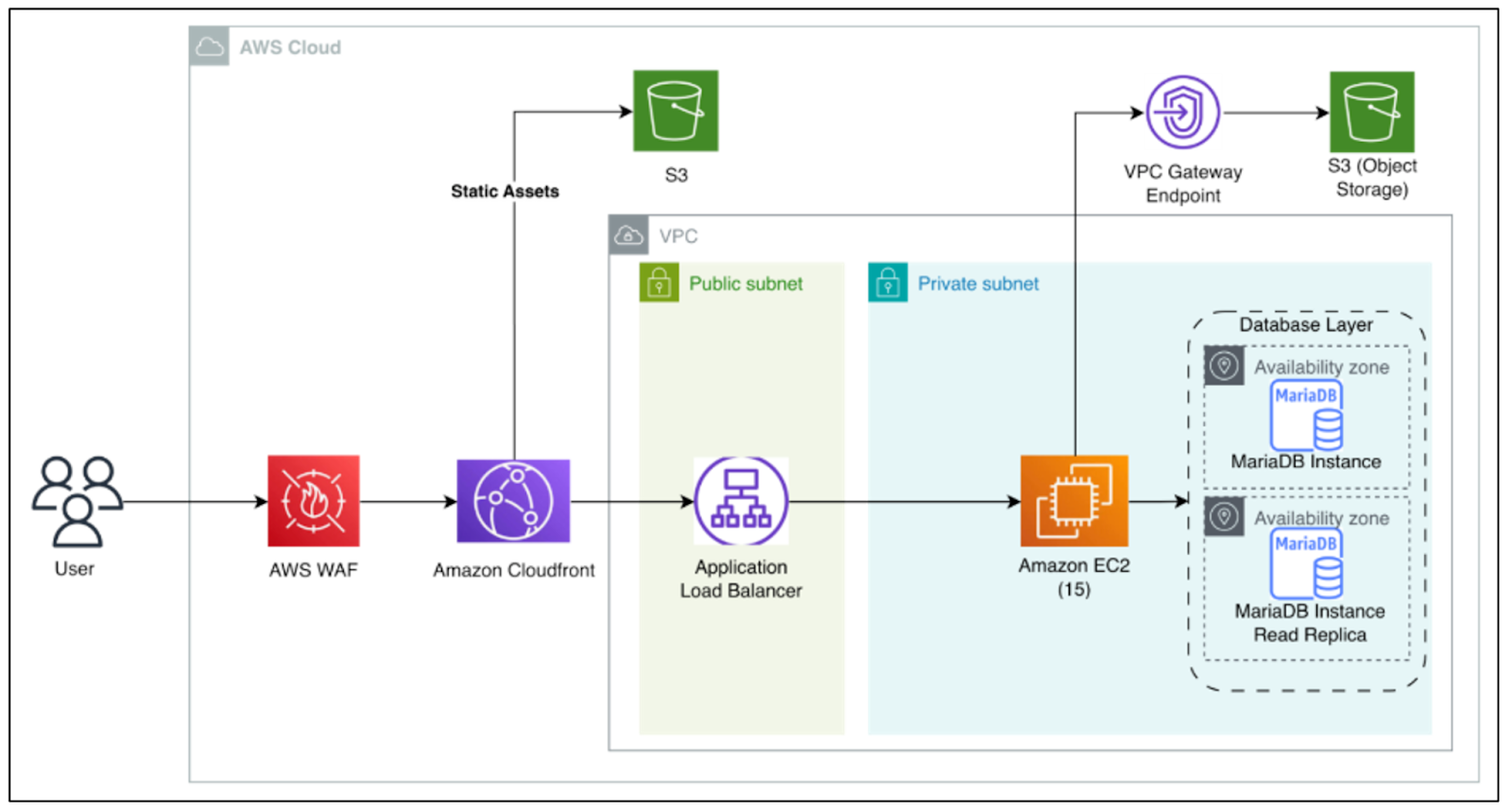
- Structured Engagement: Delivered a MAP Assessment with a migration roadmap, architecture design, and TCO analysis across four workstreams.
- Infrastructure Discovery: Documented the co-location stack (15-node web tier, 4-node Galera cluster, load balancers, network), baseline OpEx, and stateful app characteristics to inform architecture.
- Storage Migration Plan: Designed a hybrid Seed & Sync path using Snowball Edge + DataSync to migrate ~340 TB (~914 M objects) with validation layers and rollback procedures
- Database Migration: Used AWS DMS with Full Load + CDC to achieve near-zero downtime to RDS MariaDB (Multi-AZ + cross-region replica) with cost-saving reserved instance guidance.
- App Architecture Evaluation: Compared fixed 15-instance EC2 (recommended) vs Auto Scaling with externalized session/cache; recommended fixed for cost efficiency given workload patterns.
- S3 Strategy & Lifecycle: Phased Intelligent-Tiering in Year 1 and Glacier Instant Retrieval from Year 2 onward (~62% storage cost reduction), with strong security controls (encryption, bucket policies, MFA Delete).
Technologies Used
Related Case Studies
← Back to All Case Studies
Data Engineering
Legacy Data Pipeline Modernisation: Matillion to Databricks Migration
JashDS automated Green Energy's transition from legacy Matillion ETL to a cloud-native Databricks Lakehouse platform by building the Matillion to Databricks Converter (M2DC), an internal automation tool that parsed complex pipeline structures and auto-generated native PySpark/SQL notebooks with complete CI/CD orchestration. The solution reduced migration effort by 60%, compressed the timeline to ~1 pipeline suite per sprint, eliminated Matillion licensing dependencies, and achieved 100% data parity with zero quality incidents—while enabling Green Energy to leverage Lakehouse architecture for unified analytics and improved data accessibility.
Read More
Data Engineering
Azure to AWS SaaS Platform Migration
An EdTech SaaS company migrated its entire Azure-hosted student risk monitoring platform to AWS in 9 weeks — lifting and shifting 17 VMs, 12 PostgreSQL databases, and multiple application services with zero disruption to school district operations. The solution leveraged Terraform, AWS Control Tower, and a fully automated CI/CD pipeline to deliver a scalable, cost-optimized cloud foundation built for rapid expansion.
Read More
Data Engineering
Real-Time AI Chatbot Platform’s Lambda to ECS Migration
An AI chatbot startup faced critical Lambda performance issues including 100% memory utilization causing crashes, 7-8 second cold starts,Scalability issues where in multiple concurrent users using this application concurrently faced issues to use the application which includes laginess taking too much time to get the response, application crashing and completely non-functional WebSocket group chat due to protocol incompatibility between Socket.IO frontend and API Gateway WebSocket backend. Through a 4-week POC engagement, we successfully containerized Lambda functions to ECS Fargate, conducted systematic JMeter load testing up to 1,000 concurrent users, and delivered complete Terraform Infrastructure-as-Code, achieving 94% response time reduction (to sub-1-second), 100% cold start elimination, 0% error rate, and validated linear horizontal scalability while providing all technical documentation and architecture recommendations for production migration decision-making.
Read MoreHave a similar challenge?
Connect with us