

Letting Data Speak,AI Act!
Case Study
Legacy Data Pipeline Modernisation: Matillion to Databricks Migration
Overview
JashDS automated Green Energy's transition from legacy Matillion ETL to a cloud-native Databricks Lakehouse platform by building the Matillion to Databricks Converter (M2DC), an internal automation tool that parsed complex pipeline structures and auto-generated native PySpark/SQL notebooks with complete CI/CD orchestration. The solution reduced migration effort by 60%, compressed the timeline to ~1 pipeline suite per sprint, eliminated Matillion licensing dependencies, and achieved 100% data parity with zero quality incidents—while enabling Green Energy to leverage Lakehouse architecture for unified analytics and improved data accessibility.
About the Client
Green Energy is energy technology company specialising in sustainable energy solutions and data-driven operational efficiency for the utility sector. The organisation manages complex data ingestion and transformation workflows that support core business intelligence and analytics capabilities. With multiple legacy systems and a strategic shift toward cloud-native data architectures, the company recognised the need to modernise its data platform infrastructure.
The Challenge
Green Energy faced a critical business challenge centred on legacy Matillion ETL/ELT pipeline dependencies that were becoming increasingly costly to maintain while limiting scalability and innovation velocity.
- Legacy System Constraints: Green Energy operated on a legacy Matillion-based data platform that generated high licensing costs and created operational overhead. The fixed licence renewal deadline created an urgent timeline constraint for migration activities.
- Manual Migration Complexity: Traditional approaches to migrating Matillion pipelines to Databricks required extensive manual recoding and refactoring. Engineering teams faced the prospect of hand-coding baseline Databricks notebooks and orchestration logic from scratch for each pipeline, a process that was time-intensive, error-prone, and resource-heavy.
- Delivery Timeline Risk: Without automation, the migration effort threatened to exceed project timelines. Engineering teams required sustained velocity across multiple pipeline suites while maintaining system stability, creating dual demands that strained resources.
- Data Consistency & Validation Gaps: The complexity of translating Matillion components—including connectors, conditional logic (Success, Failure, Unconditional, Iteration, True/False branches), and job variables—into equivalent Databricks workflows introduced risks of data inconsistencies, missed transformation logic, and validation failures during cutover.
Business Impact: Extended migration timelines risked licence continuation costs, delayed cloud-native modernisation initiatives, and reduced engineering team capacity for innovation and new feature development. Inefficient migrations or undetected data quality issues could impact downstream analytics, reporting accuracy, and operational decision-making.
Key Results
- Reduced migration effort by 60%, enabling engineering teams to eliminate manual pipeline development and orchestration refactoring. Teams shifted from hand-coding each Databricks notebook and workflow configuration to leveraging automated code generation, reducing effort from weeks to days per pipeline suite.
- Reduced per-tenant migration timeline to 2 days, enabling the complete migration portfolio to be deployed in a single sprint (10 business days) with full quality assurance, compressing the overall project timeline and reducing the risk of exceeding fixed legacy licence exit deadlines. This delivery velocity enabled JashDS to complete the entire migration portfolio within budget and on schedule.
- Automated End-to-End Migration & Deployment Pipeline: Reduced manual infrastructure and environment setup from multiple days to minutes. The tool auto-generated CI/CD configurations (CircleCI) and Infrastructure-as-Code setup (Terraform/GCS), eliminating bottlenecks in the deployment phase.
- Achieved 100% data parity across all migrated pipelines through comprehensive validation, verifying output consistency, null counts, row counts, duplicate counts, and schema alignment between legacy Matillion and new Databricks pipelines. No data quality incidents occurred during production cutover.
Our Solution
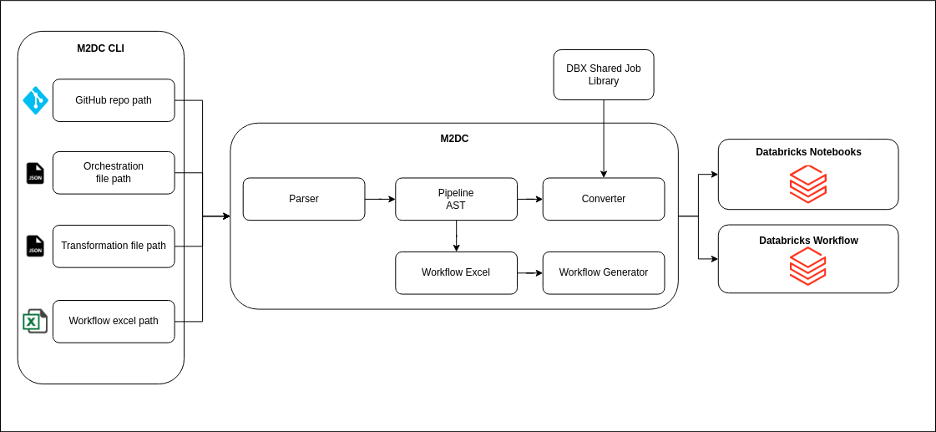
Green Energy implemented a comprehensive Matillion-to-Databricks migration strategy powered by an internal automation tool (M2DC) designed to accelerate and de-risk the migration process.
Migration Strategy & Automation Framework:
- Developed and deployed the Matillion to Databricks Converter (M2DC), an internal Python-based automation utility that parsed legacy Matillion pipeline export JSONs, resolved orchestration dependencies, and generated native Databricks notebooks and workflow definitions.
- M2DC ingested Matillion component structures—including connectors, conditional logic branches (Success, Failure, Unconditional, Iteration, True/False), and job variables—from source Git repositories and automatically translated them into executable pipeline DAGs (Directed Acyclic Graphs).
- The tool reduced manual pipeline development overhead by automating approximately 60% of baseline Databricks notebook and orchestration code generation.
Technical Implementation:
- Automated JSON & DAG Parsing: The tool ingested Matillion pipeline exports and source GitHub repositories, parsed pipeline components and connector logic into executable pipeline graphs, and translated orchestration structures into native Databricks Python notebooks.
- Workflow Definition & YAML Generation: M2DC converted pipeline dependencies and mapping structures (via Excel/JSON definitions) into Databricks Workflow YAML configurations, enabling multi-task orchestration with task dependencies and parameter passing.
- Component-Level Translation: Engineering teams carefully studied each Matillion component—including data connectors, conditional branches, and transformation logic—and mapped them to equivalent SQL and PySpark code structures. Custom transformation logic was faithfully reproduced to maintain business rule integrity.
Comprehensive Data Validation & Quality Assurance:
- Implemented a row-by-row validation script that compared outputs between Databricks and Matillion data ingestion/transformation pipelines. The validation process sorted both datasets by pre-configured key columns to ensure proper alignment.
- The validation script performed comprehensive quality checks including: null count analysis, row count verification, duplicate detection, row parity analysis, column structure validation, and schema conformance verification. This multi-dimensional validation ensured that all data transformation aspects were correctly reproduced in the Databricks environment.
- All migrated pipelines achieved 100% data parity, with zero data quality incidents during the production cutover.
Standardisation & Governance:
- M2DC enforced unified code structures, naming conventions, and parameter handling across all converted Databricks repositories, establishing consistent governance frameworks for future pipeline development and maintenance.
Technologies Used
- Python 3.10+ – Core automation framework for the M2DC conversion utility
- Apache Spark / PySpark – Native Databricks transformation engine for executing SQL and Python-based data transformations
- Databricks Workflows/Jobs – Cloud-native orchestration platform replacing legacy Matillion ETL orchestrating
- YAML / JSON – Pipeline configuration, dependency mapping, and workflow definition formats
- Terraform – Infrastructure-as-Code framework for GCS service account and permission management
- CircleCI – CI/CD automation for deploying converted Databricks workflows
- Pandas / NetworkX – Python libraries for data manipulation, ETL DAG parsing, and workflow dependency analysis
- GitHub – Version control for Matillion and Databricks pipeline repositories
- Google Cloud Storage (GCS) – Data ingestion and staging layer for raw file inputs.
Technologies Used
Related Case Studies
← Back to All Case Studies
Data Engineering
Film Advertising Analytics & Performance Tracking Platform
JashDS developed a comprehensive data warehouse and analytics platform for a film advertising company, integrating PostgreSQL databases and Google Analytics through automated ETL pipelines built with Apache Airflow on Google Cloud Platform. The solution delivered real-time campaign performance dashboards that enabled film distributors to optimize marketing strategies and track social media traffic attribution, significantly improving their ability to analyze film campaign effectiveness and make data-driven marketing decisions.
Read More
Data Engineering
Scalable Serverless AWS Architecture for Dash Cam Data Processing
JashDS developed a scalable serverless AWS architecture for a dash cam technology company, replacing their legacy FTP system with a comprehensive solution featuring ESE Fargate, Lambda functions, S3 storage, SQS and Kinesis queuing to handle video footage and telemetry data processing. The implementation supported a projected tenfold increase in data volume while providing automated scaling, reduced latency, and improved reliability for their new dash cam product line through modern cloud-native data processing pipelines utilizing Aurora RDS, ECS Fargate, and site-to-site VPN connectivity.
Read More
Data Engineering
Enterprise Cybersecurity Platform Modernization
A cybersecurity and compliance platform successfully migrated from legacy infrastructure to a modern cloud-native architecture, overcoming complex multi-tenant database challenges and fragmented data storage that threatened scalability and competitive positioning. The solution achieved improvement in data processing efficiency through implementing real-time Change Data Capture pipelines, streaming data processing with AWS Kinesis and Databricks, and centralized analytics infrastructure using Amazon QuickSight.
Read MoreHave a similar challenge?
Connect with us